03 / AI Product + Frontend Engineering
2026
Turning live draft context into useful, matchup-specific guidance.
A React and TypeScript application that combines Riot champion data, composition analysis, matchup context, and OpenAI-powered coaching to help players make better decisions during champion select.
React / TypeScript / OpenAI API / Playwright / GitHub ActionsContext before intelligence
Draft captured→Context assembled→Guidance requested
01 / The Problem
Champion select moves quickly. Generic advice usually doesn't.
Most build guides and matchup resources answer one question at a time. Champion select creates a more contextual problem: what am I playing, what am I facing, what does the enemy composition look like, and what should change because of it?
Core product question
What advice is useful for this specific draft?Contextual guidance / Not an outcome guarantee
02 / Draft Input
Useful recommendations start with useful context.
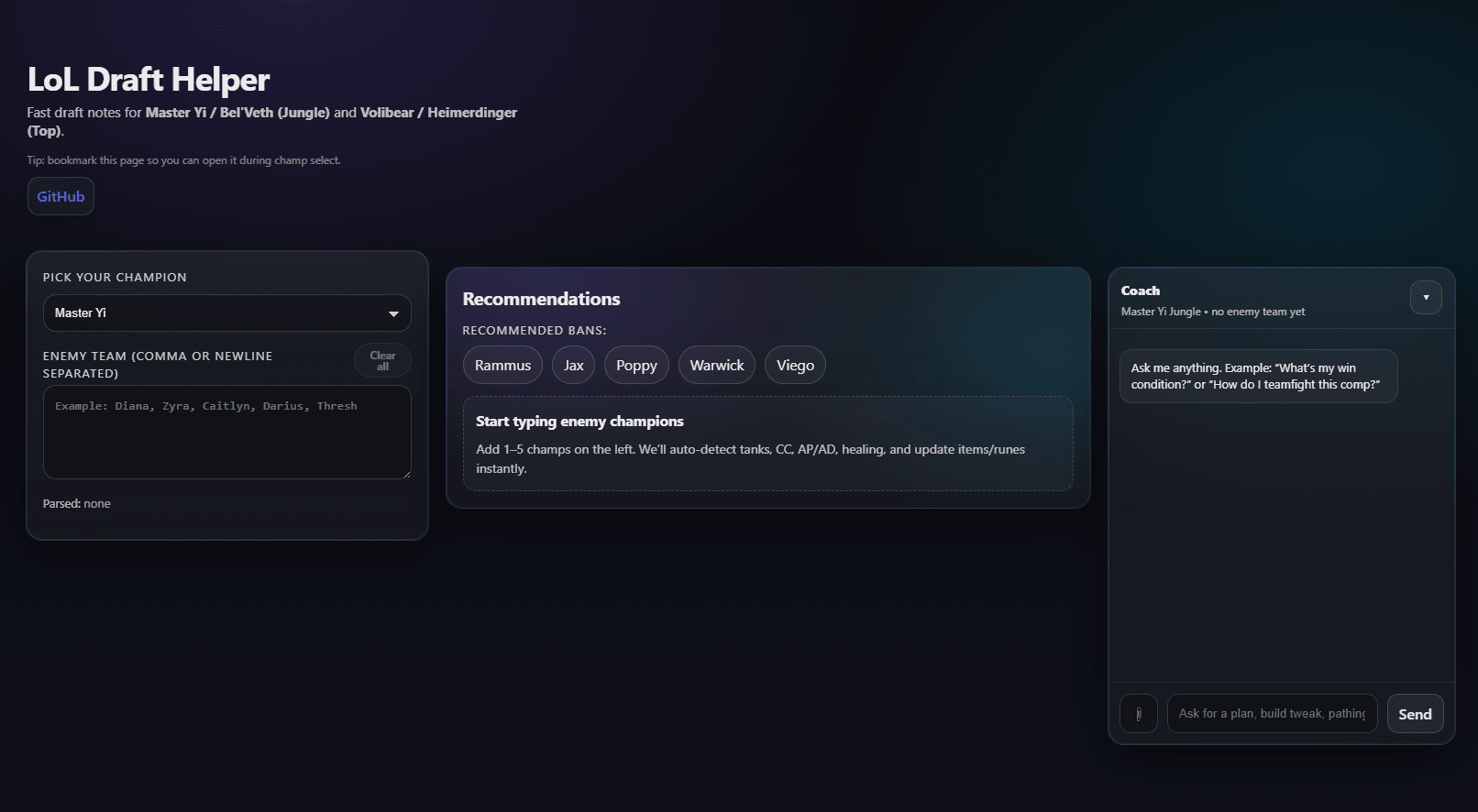
The application begins with the actual champion-select situation rather than presenting generic static advice.
Draft context
- 01Player champion
- 02Opposing champions
- 03Enemy composition
- 04Matchup information
03 / Data Layer
Build context from real game data before adding intelligence.
Riot Data Dragon champion data supports the application experience, including champion information and visual assets used throughout the draft interface.
Champion-data foundation
- 01Riot Data Dragon
- 02Champion data
- 03Champion icons
- 04Autocomplete
04 / Context
The matchup isn't just one champion versus another.
The application also considers the broader enemy composition so recommendations can respond to the draft rather than treating every matchup as an isolated one-versus-one problem.
Lane matchup+Enemy composition+Champion context
↓Relevant guidance05 / Recommendations
Turn context into something the player can act on.
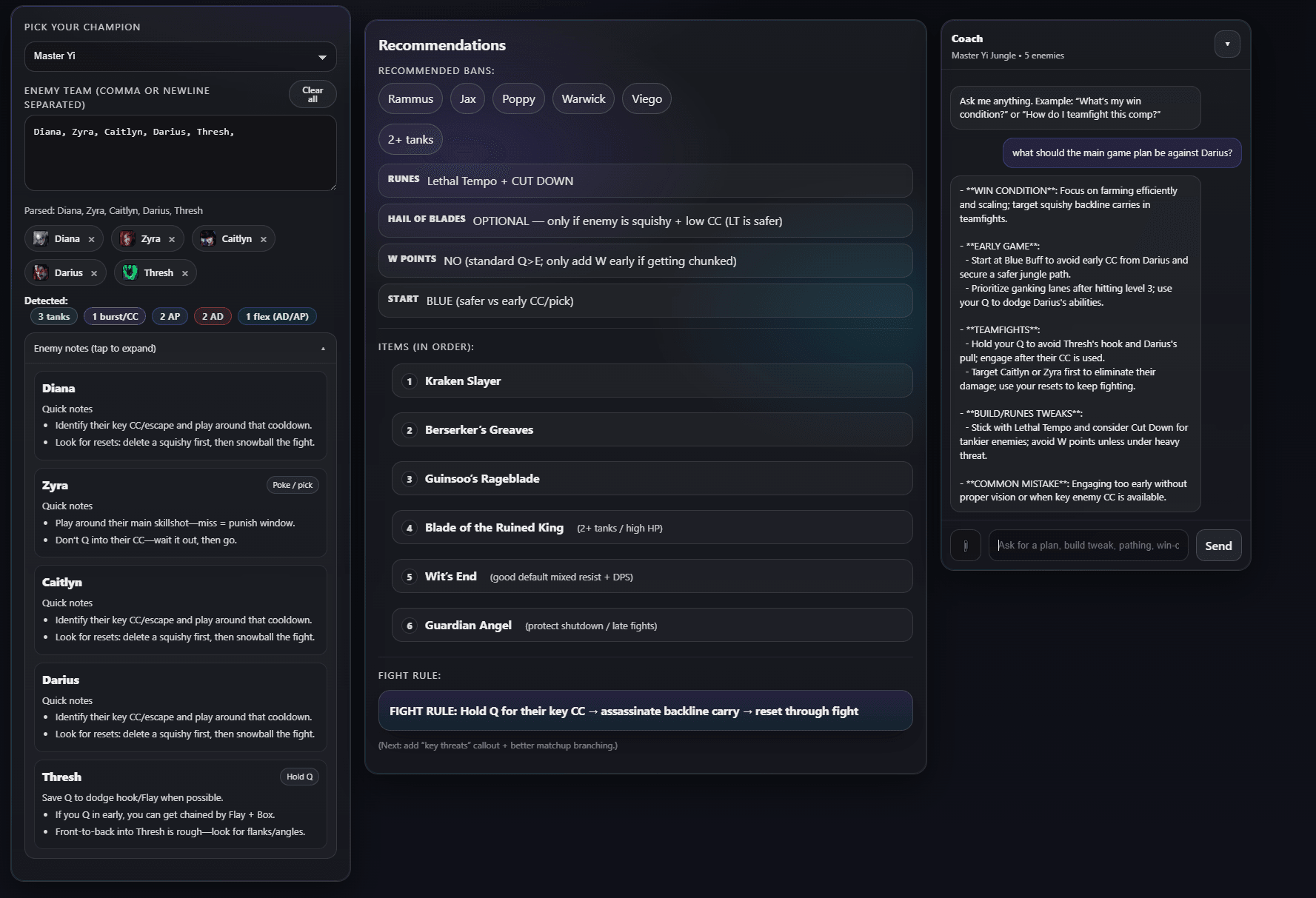
Contextual application logic surfaces recommendations from the draft, while the AI coach provides a separate path for situation-aware coaching. AI is one layer of the product, not the source of every recommendation.
Two outputs / Shared context
Draft context
06 / AI Coach
Give the model the situation before asking for advice.
Instead of opening a generic chatbot, the AI coaching experience is provided with relevant champion-select context so its response can reflect the player's champion, opposing composition, and matchup situation.
07 / System Flow
The useful part is how the pieces work together.
Context pipeline
- 01Draft input→
- 02Champion data→
- 03Matchup context→
- 04Composition analysis→
- 05Recommendations→
- 06AI coach
08 / Testing
The product isn't finished when the interface works once.
Playwright browser tests cover important user flows and are connected to GitHub Actions so application behavior is checked automatically on pushes and pull requests.
Playwright UI testsGitHub ActionsCI on push + PR
Automated check
- 01Code change→
- 02Push / PR→
- 03Playwright→
- 04User flows checked
09 / Product Thinking
AI is more useful when the product does the groundwork first.
Context before prompting
Collect relevant draft information before asking the model to provide guidance.
Product logic before AI
Use normal application logic where deterministic behavior is more appropriate instead of turning every feature into an AI request.
Guidance inside the workflow
Keep coaching connected to champion select rather than sending the user to a separate general-purpose chatbot.
Testing beyond the happy path
Automate important user flows so iteration does not quietly break previously working behavior.
10 / Build
A modern frontend with AI as one layer of the product.
The application combines a responsive React and TypeScript interface with Riot champion data, contextual recommendation logic, OpenAI-powered coaching, and automated browser testing.
Verified implementation
- 01React
- 02TypeScript
- 03Riot Data Dragon
- 04OpenAI API
- 05Playwright
- 06GitHub Actions
11 / Outcome
A draft tool built around context instead of generic advice.
The finished application brings champion data, composition analysis, matchup context, recommendations, and AI-powered coaching into one champion-select workflow, with automated testing supporting continued iteration.
End of Selected Work
Back to Selected Work←